Encouraging independence: handing over responsibility
Doing it themselves takes ten minutes; you need twenty seconds. Why those ten minutes are worth it, and how to hand over responsibility without asking too much.
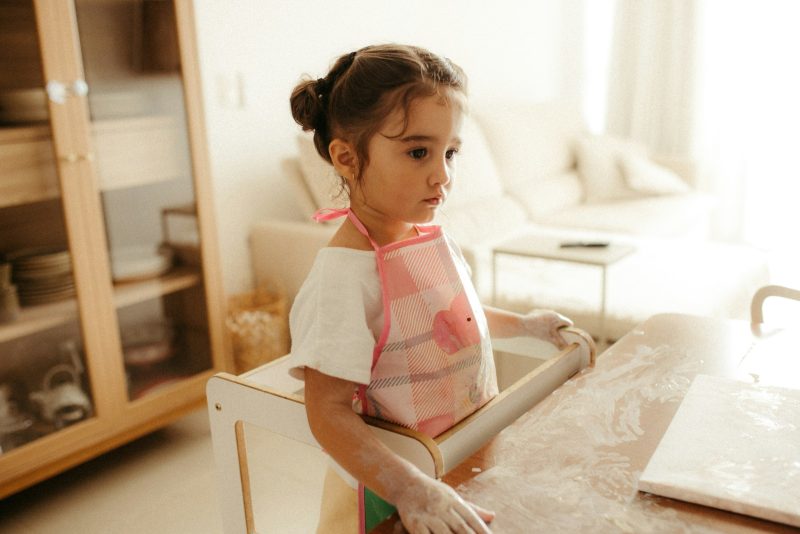
Picture a Tuesday morning. Your child is standing in front of their coat and wants to do the zip up alone. It takes a while. You glance at the clock, reach out a hand – and hear: “Noooo, myself!”
A few years later the same child stands in front of the same coat and says: “Will you do it?” Between those two sentences lies a lot of everyday life, and in it is decided how much a child trusts themselves to do.
The short version
- Independence cannot be taught, says the IFP family handbook – only allowed and supported.
- Under section 1626 of the German Civil Code, parents take account of the child's growing ability and growing need to act independently and responsibly.
- Children who contribute to the running of the household experience self-efficacy, and that strengthens their confidence.
- Practise together first, then let them do it alone: small children take on parts of a job best to begin with.
- Constantly redoing things takes the effect back out, because it tells the child it was not good enough.
Why does independence matter so much?
The educationalist Erika Butzmann writes in the IFP family handbook that independence cannot be taught; it develops out of a secure attachment and the child's own drive, and can only be allowed and supported. Parents are not passive in this – they create the opportunities.
What grows out of it is self-efficacy: the confidence that you can manage something under your own steam. According to the IFP family handbook, children experience exactly that when they contribute to the running of the household, and it strengthens their confidence.
The law thinks along these lines too. Under section 1626(2) of the German Civil Code, in caring for and bringing up their child parents take account of “the child's growing ability and growing need to act independently and responsibly” and discuss questions of parental care with the child in a way that suits their age.
What can children take on at which age?
The overview is a starting point, not a yardstick. Butzmann explicitly advises against pushing children under three towards acting independently, and recommends involving children in everyday jobs from about their fourth year.
| Age | Often already possible | What you still accompany |
|---|---|---|
| 2–3 years | Fetching shoes, carrying a beaker, putting toys in the box | almost everything, together and without hurry |
| 4–5 years | Getting dressed largely alone, brushing teeth themselves, laying the table | brushing after them, saying the order |
| 6–7 years | Packing the school bag, preparing the lunch box, their own shelf | going through it together in the evening |
| 8–9 years | Starting homework themselves, setting an alarm, knowing their appointments | reminding when something new comes up |
| 10–12 years | Taking charge of a whole area, managing pocket money, going to training alone | staying in the background, being available |
Which household jobs fit alongside is set out in detail in chores for children by age.

How do you hand over responsibility without asking too much?
Together first, then alone. Show a new job together a few times. The IFP family handbook recommends letting small children take on only parts of a job to begin with.
Allow the time. Butzmann advises leaving children the time to try things out themselves, for as long as their patience lasts. The ten minutes at the zip are not lost time; they are the practice itself. If you have no ten minutes in the morning, practise at the weekend.
Do not redo it. Straightening the badly made bed straight away sends the message that it was not good enough. The family handbook advises against constant correcting and against expecting a perfect result.
Let failures stand. Having another go after a first setback leads to particularly intensive learning, says Butzmann. The forgotten gym kit is annoying and instructive – as long as nobody brings it after them.
One area rather than separate steps. “You're in charge of the lunch box” carries further than five separate instructions. The social pedagogue Beate Weymann suggests in the family handbook starting small and adding something month by month.
Let them choose. “Would you rather lay the table or water the plants?” A child who may decide takes it on more readily.
A child does not become independent by being able to do something, but by being allowed to.
What if your child does not want to?
Look at the job first: too big, too new, at the wrong time of day? It often helps to split it in two and do the first part together. After that it usually carries on by itself.
Sometimes there is uncertainty behind it. Then less driving and more trust helps: “You managed that last week. I'm in the kitchen if you need me.” And sometimes the day is simply too full. One job that works reliably is worth more than three you argue about. How to accompany homework without supervising is covered in homework without arguments.
How Fleißstern helps with letting go
In Fleißstern the next step is not up to you; it is on the list. In the children's view your child only sees what is due today, ticks it off themselves and watches the stars come in – without you standing beside them.
For jobs where you do want to check once more, the stars only come after your confirmation; with Premium your child can attach a photo as proof. That way the responsibility stays with them, and you do not have to chase after it.
Common questions
How can I encourage my child's independence?
Above all by creating opportunities and not taking over what your child can manage themselves. According to the IFP family handbook, independence cannot be taught, only allowed and supported. Time to try things out, practising together at first, and not redoing things all help.
From what age should children take on responsibility?
Small jobs suit from about the age of two. The educationalist Erika Butzmann advises involving children in everyday jobs from about their fourth year, but not pushing younger children towards acting independently. What matters is less the age than whether your child manages the job well.
What if my child does a job badly?
Try not to redo it straight away. The IFP family handbook advises against constant correcting and against expecting a perfect result – otherwise the child learns that it will never be enough anyway. If something really does not work, show them together next time rather than silently putting it right afterwards.
Am I giving my child too much responsibility?
The sign is usually visible: your child becomes constantly unsure, avoids the job, or needs help every time. Then it is too big. Take a step back, do the first part together again, and hand the responsibility over again later.
Sources
- Entwicklung der kindlichen Selbstständigkeit (Erika Butzmann) – IFP-Familienhandbuch, Bavarian State Institute of Early Childhood Research
- Familiäre Alltagsaufgaben: Kinder sinnvoll einbeziehen – IFP-Familienhandbuch
- Ist es sinnvoll, dass Kinder im Haushalt mithelfen? (Beate Weymann) – IFP-Familienhandbuch
- Section 1626 of the German Civil Code (BGB) – parental care, principles – Federal Ministry of Justice, gesetze-im-internet.de