Chores for children: what suits which age?
First children want nothing more than to help, a few years later all that comes back is “in a minute”. Which jobs suit which age, and how helping becomes a habit.

Picture an ordinary Tuesday evening. The pasta is about to boil over, there are still pens and craft paper on the dining table, and the question of who can help for a moment gets a long, drawn-out “in a minute” from the bedroom. In the end you clear the table yourself – quicker that way.
A few years earlier it was exactly the other way round. Back then the same child absolutely had to push the vacuum cleaner and join in the cooking “properly”. With that much help, everything took twice as long.
The short version
- Even two- and three-year-olds can take on small jobs, such as putting toys in a box or matching pairs of socks.
- Primary-school children manage considerably more: wiping the table, loading and emptying the dishwasher, helping with the cooking, packing their own lunch box.
- In Germany, children living in the parental home are required by section 1619 of the Civil Code to help in the household as far as their strength allows.
- Helping works best with a few clearly described jobs, fixed times and a list to tick off.
- The German Youth Institute advises against tying ordinary help around the house to pocket money.
Why should children help around the house?
Part of it is of course that not everything should fall to the adults. But there is more in it for children: according to the family handbook of the Bavarian State Institute of Early Childhood Research (IFP), children who contribute to the running of the household experience self-efficacy, and that strengthens their confidence. Self-efficacy means trusting that you can manage something under your own steam.
In a US long-term study of nearly 10,000 children, those who helped out more often in the year before year one rated their social and academic skills and their satisfaction with life higher, on average, by year three (White, DeBoer & Scharf, 2019). An Australian study drawing on reports from 207 parents found links in children aged 5 to 13 between jobs such as preparing a meal and both working memory and impulse control (Tepper, Howell & Bennett, 2022). Both are associations, not proof of cause and effect.
Which jobs suit which age?
The table follows the age examples of the American Academy of Child and Adolescent Psychiatry (AACAP) and the IFP family handbook, with some typical everyday jobs added. It is a starting point, not a yardstick.
| Age | Often manageable | Worth knowing |
|---|---|---|
| 2–3 years | Putting toys in the box, matching pairs of socks, helping unpack the shopping, helping with drying up | Joining in matters more than the result |
| 4–5 years | Laying the table, taking their own plate to the sink, helping feed a pet, making the bed (not perfectly), cracking eggs | Short jobs with a clear end |
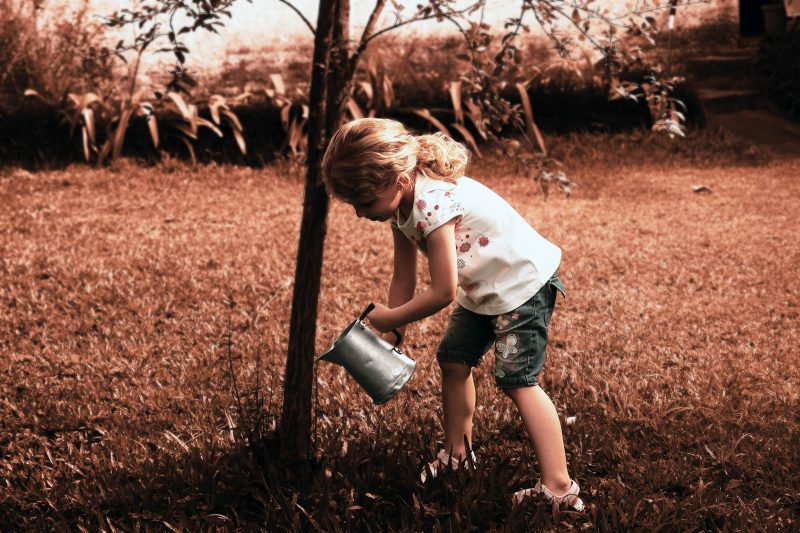
| 6–7 years | Wiping the table, putting clean laundry away, sweeping, watering plants, packing the school bag | Practise together first, then alone |
| 8–9 years | Loading and emptying the dishwasher, helping cook, packing their own lunch box, taking out the rubbish | Fixed times help more than reminders |
| 10–12 years | Changing the bed, cleaning the kitchen or bathroom, helping in the garden, cooking simple meals | Responsibility for a whole area |
Your child does not have to manage everything in their age group. Better to pick two or three jobs that fit your everyday life.
How does helping become a habit?
Concrete, not general. “Give me a hand” is hard to grasp; “please put the plates in the dishwasher” is clear. The AACAP advises precise agreements and fixed sequences such as “tidying up before dinner”.
Together first, then alone. Show a new job together a few times. The IFP family handbook recommends letting small children take on only parts of a job to begin with.
Do not redo it. Straightening the badly made bed straight away quickly sends the message that it was not good enough. The family handbook advises against constant correcting and against expecting a perfect result.
Not perfect, but done themselves: that is what helping out is about.
Start small. One or two fixed jobs are enough to begin with. The social pedagogue Beate Weymann suggests in the family handbook adding new ones month by month.
Choosing and swapping. “Would you rather lay the table or water the plants?” Weymann also advises rotating the jobs regularly, so that everyone takes a turn at each of them.
Make it visible. A list to tick off has proved itself, according to the IFP family handbook. It takes the constant reminding off your shoulders and shows your child what they have already managed.
What if your child does not feel like it?
The AACAP advises first understanding why: is the job too big, the moment awkward, or the day simply too full? At the same time it recommends choosing your battles, because an untidy room is not the end of the world.
Better to keep one job reliably than to argue on five fronts at once. If the conflict about it keeps growing over a longer period, a conversation at your paediatric practice can help identify other causes. Whether rewards help is covered in reward charts for children, and how pocket money fits in is in pocket money, stars, or both?
How Fleißstern helps with pitching in
A list to tick off is exactly the idea behind Fleißstern. You set up jobs such as “lay the table” once, and the app brings them back on the right days: daily, on particular weekdays, or every few days. In the children's view your child only sees what is due today, ticks it off themselves and sees straight away how many stars have come in.
For important jobs the stars only come after your confirmation. The statistics show what regularly gets left, as a reason to talk rather than a report card.
Common questions
At what age should children help around the house?
Small jobs are possible from about two: putting toys away or matching pairs of socks, for instance. According to the IFP family handbook, children that age often want to help anyway. The advice is to start with small jobs and add new ones bit by bit.
Do children have to help around the house?
Yes, within their means. Under section 1619 of the German Civil Code, a child who belongs to the parental household and is brought up or supported by their parents is obliged to help in the household in a way that suits their strength and their situation in life. In daily life, though, clear agreements achieve more than a reference to the law.
How much should children help around the house?
Neither the AACAP nor the IFP family handbook names a fixed number of hours. What matters is that the jobs suit the child's age and strength. To begin with, one or two fixed jobs a day that the child manages well are enough.
Should children be paid for housework?
For ordinary help, probably not. The German Youth Institute advises against tying regular help around the house to pocket money. For special extra jobs, such as substantial work in the garden, a small payment agreed beforehand and kept separate from pocket money can make sense.
Sources
- Familiäre Alltagsaufgaben: Kinder sinnvoll einbeziehen – IFP-Familienhandbuch, Bavarian State Institute of Early Childhood Research
- Ist es sinnvoll, dass Kinder im Haushalt mithelfen? (Beate Weymann) – IFP-Familienhandbuch
- Chores and Children, Facts for Families No. 125 – American Academy of Child and Adolescent Psychiatry (AACAP)
- White, DeBoer & Scharf (2019): Associations Between Household Chores and Childhood Self-Competency. Journal of Developmental & Behavioral Pediatrics 40(3) – PubMed
- Tepper, Howell & Bennett (2022): Executive functions and household chores. Australian Occupational Therapy Journal 69(5) – PubMed
- Section 1619 of the German Civil Code (BGB) – services in the home and the family business – Federal Ministry of Justice, gesetze-im-internet.de
- Taschengeld und Gelderziehung – Expertise mit aktualisierten Empfehlungen (2025) – German Youth Institute (DJI)