Homework app for children: what it can and cannot do
A homework app for children won't explain fractions. It can do something else: hold the agreement, so you don't have to renegotiate it every afternoon.
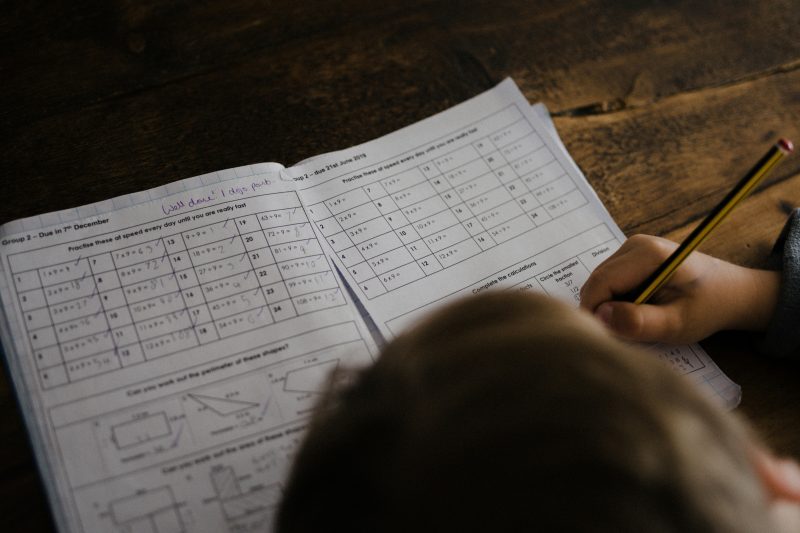
Picture a Wednesday, half past four. You come out of the kitchen and ask for the second time whether the homework has been started. Your child says “in a minute”, and you both know that minute will turn into seven o'clock.
Sooner or later you think: surely there's something for this. There is — it just doesn't take off your hands what you were hoping for.
The short version
- A homework app for children won't explain maths. It holds the agreement you would otherwise renegotiate every day.
- Less supervision helps more than more: in one study, frequent parental help was associated with weaker achievement growth, while help children experienced as supportive was associated with better growth.
- Three features are genuinely useful: a fixed start time with a reminder, an end time, and a look back after a few weeks.
- klicksafe recommends children's apps with no advertising, no in-app purchases and no links out.
- In Germany, children under 16 cannot consent to the processing of their own data. A good children's app therefore needs no separate account for the child at all.
Homework app for children: what it actually takes off your hands
A homework app for children replaces neither the teacher nor you. What it takes over is the reminding — and that is more than it sounds. The friction rarely comes from the task itself, but from the question before it: when do we start?
The IFP family handbook advises leaving enough time for movement after the school day and deciding together which start time suits best. Against dawdling it suggests an egg timer or a fixed end time in the daily plan. Both are agreements, not parenting tricks — and agreements hold better when they are written down somewhere rather than kept in a parent's head.
That is exactly where the benefit lies: the plan does the reminding, not you. A small difference with a large effect, because it takes you out of the role of the one who nags.
Why less supervision works better
It is tempting to expect surveillance from an app: has it started? For how long? How much is done? Research rather advises against it.
In a longitudinal study of 1,685 sixth-graders, frequent parental help was associated with weaker achievement growth. Help that children experienced as supportive went with better development, help experienced as intrusive with worse (Moroni et al., 2015). The educational researcher Britta Kohler writes in the IFP family handbook that constant interference and control in particular lead to weaker achievement growth.
Translated to an app: a feature that reports minute by minute what your child is doing does not solve your problem — it just moves the argument onto a screen. What helps is what your child can operate alone.
An app your child ticks off is a different thing from an app that watches your child.
Which features are worth having
A task that comes back by itself. Homework is not a project, it is Monday to Friday. Anything you can set up once and then forget saves you the daily typing.
A time with a reminder. The agreed start time lives in the plan, not in your head. After a break, not straight after school.
An end time. In North Rhine-Westphalia, for example, homework at schools without compulsory all-day provision should be manageable in 30 minutes in years 1 and 2 and in 45 minutes in years 3 and 4, without outside help. Whatever is not finished goes to school unfinished, says the IFP family handbook — ideally agreed with the teacher beforehand.
A look back. After a few weeks, simple statistics show which days regularly go wrong. That is a conversation starter, not a mark.
Nothing else. The more an app can do, the more your child has to operate. What a seven-year-old cannot work out alone, they will not use.
What to watch for with ads and data
klicksafe sets out clear criteria for recommendable children's apps: they do without advertising and without links to social networks, advertising pages or app stores, and they offer no way to buy paid extras from inside the app. Parents should also check the permissions before downloading.
There is one more point many apps skip: under Article 8 of the General Data Protection Regulation, a child's consent to the processing of their data is only valid from the age of sixteen; below that, the parents must consent. Germany kept the threshold at sixteen. A homework app for children that demands an email address and its own account from the child is therefore making life harder than it needs to be — for itself and for you.
A good question before you download: what does the app hold about my child that it wouldn't need to? A first name is enough for a task list.
When paper is just as good
One child, a fixed afternoon, one parent at home: a magnetic board on the fridge covers that, and it never runs out of battery. An app pays off if at least one of these applies:
| Situation | Why the app helps |
|---|---|
| Two homes | Both households see the same state of play, without asking |
| Siblings | Each child has their own list instead of one shared board |
| Changing care | Grandma, after-school club and parents all know the same thing |
| You are out in the afternoon | The reminder arrives without you |
How to make the afternoon calmer without any app is covered in Homework without arguments.

How Fleißstern handles homework
In Fleißstern you set up “homework” once as an afternoon task, Monday to Friday and with a fixed time. Your child gets the reminder, so you don't get the job of remembering. In the child view they only see what is due today, tick it off themselves and collect stars for it.
For tasks you want to check, the stars only count once you have confirmed them. If getting started is the hard part — a case for which the IFP family handbook expressly suggests a small reward for starting — you can set up “started homework” as a task of its own.
Your child needs no account and no email address for this. There is no advertising, no chat, and the data sits on servers in Germany.
Common questions
What is the point of a homework app for children?
It holds the agreement that is otherwise renegotiated daily: when work starts, for how long, and what happens if it isn't finished. With the actual maths it won't help. The IFP family handbook recommends exactly these agreements — a break after school, a jointly chosen start time and an end time.
From what age does an app like this make sense?
From the moment a child can read what is on the list themselves — usually some time during year one. What matters less is age than handling: anything your child cannot open and tick off without you takes nothing off your hands.
What should you look for when choosing one?
klicksafe advises apps without advertising, without in-app purchases and without links to social networks or shops, and recommends checking permissions before downloading. Then there is data protection: in Germany children under sixteen cannot consent themselves, so a children's app should store as little as possible about the child.
Doesn't an app like this make children less independent?
That depends on who operates it. An app parents use to monitor reinforces control — and control was associated with weaker achievement growth in studies. An app that belongs to the child and that they tick off themselves goes the other way: the plan does the reminding, not the adult.
Sources
- Hausaufgaben – Der tägliche Kampf muss nicht sein (Carmen Wöhler) – IFP-Familienhandbuch, Bavarian State Institute of Early Childhood Research
- „Wir“ müssen noch Hausaufgaben machen!? (Britta Kohler) – IFP-Familienhandbuch, Bavarian State Institute of Early Childhood Research
- Moroni et al. (2015): The Need to Distinguish between Quantity and Quality in Research on Parental Involvement. The Journal of Educational Research 108(5) – ERIC, US Department of Education
- Decree on lesson times, weekly hours, the five-day week, class tests and homework at general education schools (BASS 12-63 No. 3) – Ministry of Schools and Education of North Rhine-Westphalia
- Apps sicher nutzen – klicksafe, EU initiative for safer internet use
- Article 8 GDPR – Conditions applicable to child's consent – General Data Protection Regulation, dsgvo-gesetz.de