Praising children well: what praise does and how it lands
“Well done” slips out easily. What the research says about praise for effort and about inflated praise – and what recognition sounds like when it reaches a child.
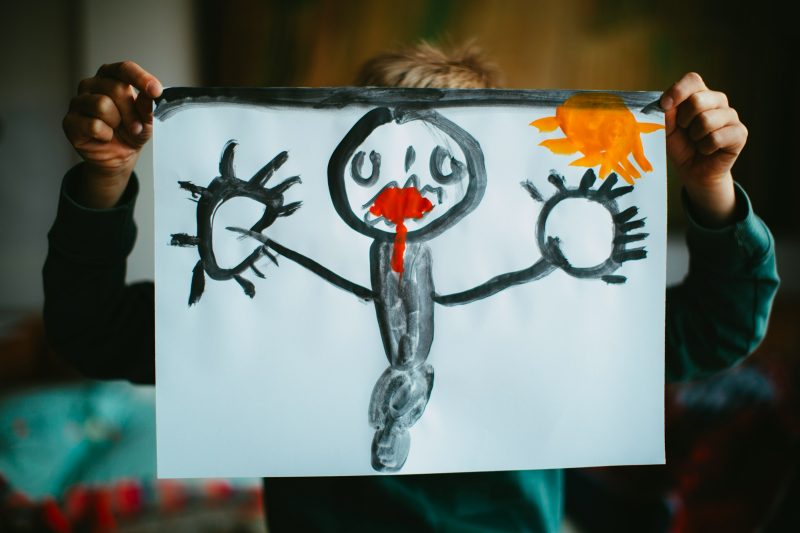
Picture your son coming into the kitchen with a drawing: “Look.” You are stirring a pot, glance over and say, “Wow, that's lovely.” He stays where he is and asks: “What's lovely about it?”
A fair question, really. Praise is quickly said, but children often notice exactly whether somebody actually looked.
The short version
- Praise and recognition matter: the German Federal Institute for Public Health (BIÖG) advises not to be sparing with them, but to praise in proportion.
- In experiments, children praised for their effort kept going after a setback more readily than children praised for their intelligence.
- Inflated praise such as “incredibly beautiful” led children with low self-esteem to choose harder tasks less often.
- According to a review, praise works best when it is sincere, strengthens a child's sense of choice, and avoids constant comparisons.
- Not every study found the same thing: work with 624 children, including a repeat of the best-known experiment, largely did not find the effects.
Should you praise children?
Yes, say the experts – just not any old way. The BIÖG writes that constant criticism and nagging wears a child down, and advises not to be sparing with praise and recognition. At the same time it recommends praising in proportion, because children have a fine sense of whether praise is inflated, careless or heartfelt.
A meta-analysis – an evaluation of many studies – found that positive feedback strengthened interest in an activity on average, although less clearly in children than in university students (Deci, Koestner & Ryan, 1999). Whether praise helps, harms or does nothing at all depends on several conditions, according to a review (Henderlong & Lepper, 2002). A short response is enough, says the AOK's ADHD parent training; children do not have to be praised to the skies.
Person praise or process praise: what is the difference?
Person praise judges the child: “You're so clever.” Process praise describes what they did: “You tried several ways until it worked.”
In six experiments, researchers praised year-six pupils either for their intelligence or for their effort. After a setback, the children praised for intelligence persisted less, enjoyed the tasks less and performed worse. They were also more likely to see intelligence as a fixed trait (Mueller & Dweck, 1998).
Something similar showed up in five- and six-year-olds: after praise directed at them as a person, they reacted to setbacks more helplessly and blamed themselves more than after praise for how they had gone about it (Kamins & Dweck, 1999). And in a long-term study of 53 families, children whose parents had more often praised their effort between the ages of one and three were, at seven or eight, more likely to believe that abilities can be developed (Gunderson et al., 2013).
Where the research runs into its limits
It is not quite that simple, though. In several studies with a total of 624 children aged 9 to 13 in China, including a repeat of the 1998 experiment, there were barely any differences in motivation or in how the children handled failure (Li & Bates, 2019). Two meta-analyses also found only weak links between believing that abilities can change and achievement at school, and only small effects from programmes designed to encourage that belief (Sisk et al., 2018).
So describing praise is no magic trick. It is, however, an honest response that shows somebody looked.
Can you praise a child too much?
Inflated praise can backfire. In one study, adults gave especially effusive praise – “incredibly beautiful” rather than “beautiful” – precisely to the children with low self-esteem. In an experiment, that kind of praise led those children to choose harder tasks less often; for children with high self-esteem it was the other way round (Brummelman et al., 2014). Henderlong and Lepper's review sets out when praise supports motivation: when it comes across as sincere, when it puts success down to things a child can influence, when it strengthens their sense of choice, when it avoids constant comparisons, and when it conveys expectations they can meet.
What praise sounds like when it lands
| Instead of | Better |
|---|---|
| “You're so clever.” | “You stuck with it, even when the task was hard.” |
| “That's the most beautiful picture in the world.” | “You mixed a lot of different blues. Will you tell me what's happening there?” |
| “Great” in passing | “Thank you for laying the table without my having to ask.” |
| “You're faster than your sister.” | “Today you tied your shoes all by yourself for the first time.” |
The ADHD parent training also advises praising promptly, and especially when a child has taken something on unprompted. It suggests talking over in the evening what went well during the day. Why comparisons between siblings are tricky is covered in when siblings compare themselves.
Praise and rewards: where is the difference?
Praise is a response in words or gestures. A reward is something a child receives: a sticker, an outing, a privilege. In Deci, Koestner and Ryan's meta-analysis, expected tangible rewards weakened inner motivation, while positive feedback strengthened it. When rewards still make sense is set out in reward charts for children.
How Fleißstern makes recognition visible
Stars are no substitute for praise, but they show what a child has managed. In the children's view a ring fills up with every task done, and the star account shows every star with its history. For help given spontaneously you can award extra stars by hand – or simply say what you noticed.
The statistics show for each child what is going well. That fits the tip from the parent training: take a few minutes in the evening and talk about what went well today.
Common questions
Should you praise children?
Yes. The German Federal Institute for Public Health advises not to be sparing with praise and recognition, but to praise in proportion, because children have a fine sense for inflated or careless praise. What helps is praise that is honest and describes what the child did.
Can you praise a child too much?
Inflated praise can backfire. In one study, children with low self-esteem chose harder tasks less often after effusive praise. A short response is enough, says the AOK's ADHD parent training.
How do you praise a child well?
Concretely, and about what the child did rather than what they are. Instead of “you're so clever”, something like “you stuck with it, even when it was hard”. Praising promptly helps too, as does using honest words rather than superlatives and leaving out comparisons with other children.
What is the difference between praise and a reward?
Praise is a response in words or gestures; a reward is something tangible such as a sticker, an outing or a privilege. In a meta-analysis of 128 studies, positive feedback strengthened inner motivation, while expected tangible rewards tended to weaken it.
Sources
- Mueller & Dweck (1998): Praise for intelligence can undermine children's motivation and performance. Journal of Personality and Social Psychology 75(1) – PubMed
- Kamins & Dweck (1999): Person versus process praise and criticism: implications for contingent self-worth and coping. Developmental Psychology 35(3) – PubMed
- Gunderson et al. (2013): Parent praise to 1- to 3-year-olds predicts children's motivational frameworks 5 years later. Child Development 84(5) – PubMed
- Brummelman et al. (2014): “That's not just beautiful – that's incredibly beautiful”: the adverse impact of inflated praise on children with low self-esteem. Psychological Science 25(3) – PubMed
- Henderlong & Lepper (2002): The effects of praise on children's intrinsic motivation: a review and synthesis. Psychological Bulletin 128(5) – PubMed
- Deci, Koestner & Ryan (1999): A meta-analytic review of experiments examining the effects of extrinsic rewards on intrinsic motivation. Psychological Bulletin 125(6) – PubMed
- Li & Bates (2019): You can't change your basic ability, but you work at things, and that's how we get hard things done. Journal of Experimental Psychology: General 148(9) – PubMed
- Sisk et al. (2018): To What Extent and Under Which Circumstances Are Growth Mind-Sets Important to Academic Achievement? Two Meta-Analyses. Psychological Science 29(4) – PubMed
- Kinder gut erziehen – kindergesundheit-info.de, German Federal Institute for Public Health (BIÖG)
- Wie können Sie loben? (ADHS-Elterntrainer) – AOK-Bundesverband